
Why Is My AC Not Cooling My Home in Brownsville TX?
Is your AC running but not cooling your Brownsville home? Discover the most common reasons and what to do about each, explained by local HVAC experts familiar with South Texas heat.
The Short Answer
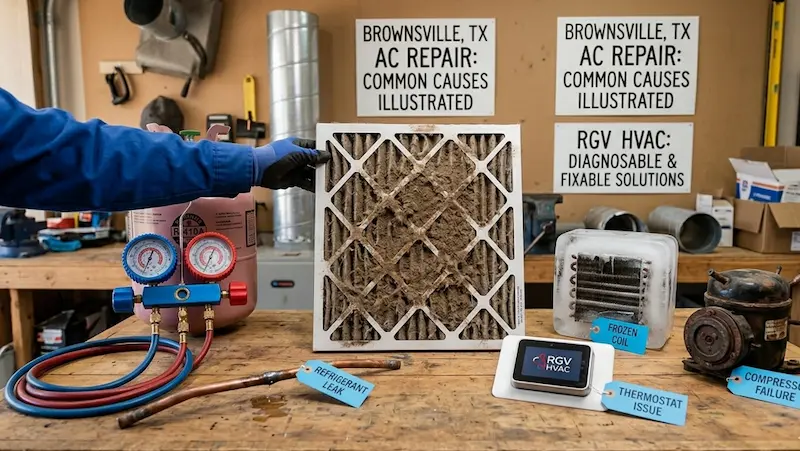
If your AC is not cooling your home in Brownsville TX, the most likely causes are a dirty air filter, low refrigerant from a leak, a frozen evaporator coil, a failing compressor, or a thermostat issue. Sometimes, your system may be undersized for the extreme heat and humidity Cameron County summers bring. The good news is many of these problems are diagnosable and fixable, and some can be addressed before you make a phone call.
Why This Problem Hits Harder in Brownsville Than Most Cities
Before diBefore exploring specific causes, it helps to understand what your air conditioning system faces in South Texas. Brownsville sits near the southern tip of the state, just across the Rio Grande from Matamoros, Mexico. The climate is brutal on HVAC equipment in ways northern city homeowners rarely experience. in Brownsville push average high temperatures to around 93°F in August, with overnight lows rarely dropping below 80°F. Layer on top of that a year-round average humidity level of approximately 76%, and your air conditioning system is not just fighting heat. It is simultaneously working to remove enormous amounts of moisture from the air inside your home. That combination puts every component of your HVAC system under tremendous, sustained stress.
Units that might last 15 years in cooler climates often need replacement in 8 to 10 years in South Texas because of high humidity, salt air, and dust from the Gulf Coast environment. If your system seems to age faster than it should, it is not your imagination. This is the reality of living in the Rio Grande Valley.
Is Your AC Running But Not Cooling? Start Here
When homeowners in neighborhoods like Southmost, Los Fresnos, Rancho Viejo, or West Brownsville call an HVAC technician and say their air conditioner is running but not cooling, the technician typically walks through a short checklist before assuming anything serious is wrong. You can do the same thing right now.
Before scheduling a service call, check the thermostat settings to make sure the system is set to cool, replace or clean the filter if it is clogged, verify that the outdoor condenser unit is free of debris, inspect your circuit breakers to confirm the system has power, and check your air vents for obstructions like furniture or curtains.
These basic checks take less than ten minutes and can sometimes resolve the issue entirely. If everything checks out and your home is still not reaching the set temperature, then one of the more specific causes below is likely responsible.
The Most Common Reasons Your AC Is Not Cooling in Brownsville TX
1. Clogged or Dirty Air Filter
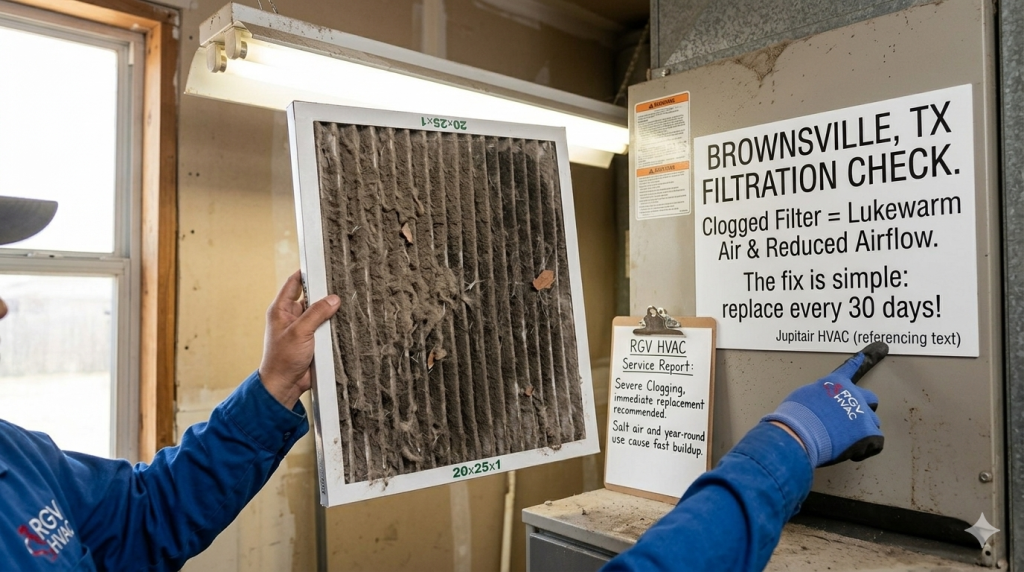
A clogged air filter is the most common cause of cooling problems in residential AC systems. When the filter fills with dust, pet dander, pollen, and debris, airflow across the evaporator coil drops dramatically. Without enough airflow, the coil cannot efficiently absorb heat from your home’s air, and your system blows lukewarm air at best
In Brownsville, this problem develops faster than in many other cities. The mix of outdoor dust, coastal particulates, and homes running AC nearly year-round means filters clog much faster than in mild climates. Most HVAC professionals in the Rio Grande Valley recommend checking and replacing your filter every 30 days during peak summer months instead of every 90 days as the packaging suggests.
The fix is simple: turn off the system, remove the filter, and hold it up to a light. If you cannot see light through it, replace it before running the system again.
2. Low Refrigerant Caused by a Leak
Refrigerant, whether R-410A or the older R-22, is the chemical that makes cooling possible. It flows between your indoor evaporator coil and outdoor condenser unit, absorbing heat from inside your home and releasing it outside. When refrigerant levels drop due to a leak, your air conditioner loses its ability to cool effectively.
A refrigerant leak can cause your AC system to blow warm air, run for longer periods without adequately cooling your home, or ultimately damage the compressor and cause complete system failure.
Signs of a refrigerant leak in your Brownsville home include ice forming on the copper refrigerant line entering your house, a gradual decline in cooling over weeks, a hissing or bubbling sound from the unit, higher electricity bills, and the system running longer without reaching the set temperature.
Low refrigerant is almost never due to the refrigerant being “used up.” Your system is a closed loop. If the level is low, there is a leak that must be located and repaired by a certified HVAC technician. Simply topping off refrigerant without fixing the leak is like putting air in a flat tire without patching the hole.
3. Frozen Evaporator Coil
This surprises most homeowners the first time because it seems counterintuitive. How can a system that produces cold air develop ice that stops it from working?
The evaporator coil, in your indoor air handler, needs a steady flow of warm air to function correctly. When airflow is restricted by a dirty filter, blocked return vents, or a failing blower motor, the coil temperature drops below freezing and ice forms. Once enough ice builds up, the coil is insulated from the air it needs to condition, and cooling stops.
If your AC keeps freezing up even after you change the filter, the likely causes are low refrigerant from a leak, blocked return vents, collapsed or disconnected ductwork, a failing blower motor, or a dirty evaporator coil.
If you suspect a frozen coil, turn the system off and let it thaw before restarting. Running a frozen system forces the compressor to work abnormally and can cause permanent damage. After it thaws, replace the filter and restart the system with the fan running alone to circulate air. If it freezes again, call a licensed HVAC technician.
4. Dirty or Blocked Condenser Coils
Your outdoor condenser unit, on the pad outside your home, releases heat extracted from indoors into the outside air. Wrapped around it is a large coil with thin metal fins designed to maximize heat transfer. When these fins and coils become coated with dirt, grass clippings, cottonwood, or debris, the unit cannot release heat effectively. Heat builds up inside, and cooling performance drops significantly.
When operating correctly, the condenser fan draws air into the outdoor unit through the condenser coil to pull heat energy out of your home. A blocked or clogged condenser coil undermines this entire process.
In Brownsville, outdoor condenser units face an additional threat that units elsewhere do not: salt air from the Gulf Coast. Salt air causes corrosion on metal fins and coil surfaces over time, reducing heat transfer efficiency even when the unit looks clean. This is why regular professional maintenance is especially critical for Brownsville homeowners compared to those in drier inland regions.
Keep the condenser clear by gently hosing it down from the inside out to remove debris and keeping vegetation trimmed at least two feet away from all sides of the unit.
5. Failing or Failed AC Compressor
The compressor is the heart of your air conditioning system. It pressurizes the refrigerant so heat exchange can occur. When the compressor fails or seizes, the system may run and the fan may operate, but no cooling happens because the refrigerant is not moving as it should.
If your AC is not cooling and a damaged compressor is to blame, full compressor replacement using manufacturer-grade components is the recommended solution.
Symptoms of a failing compressor include a hard start where the system struggles to turn on and sometimes trips the circuit breaker, a loud clunking or clicking noise during startup, warm air blowing from the vents after extended run time, and excessive outdoor unit vibration. Because compressors are expensive, many HVAC professionals in Brownsville also discuss whether the system’s age and condition make full replacement a smarter investment than replacing the compressor alone.
6. Incorrect Thermostat Settings or a Faulty Thermostat
This sounds obvious, but it is worth reviewing carefully because the thermostat is the brain of your cooling system. A thermostat set to the wrong mode, calibrated incorrectly, or failing electronically can make a perfectly functioning AC system seem like it is not working at all.
If your thermostat is set to heat or constant fan operation, sometimes labeled “on,” the system will circulate air without cooling it. Switching back to cooling mode and waiting a few minutes will resolve this.
Beyond incorrect settings, thermostats can fail by sending wrong signals, reading temperatures inaccurately due to poor placement near heat sources or direct sunlight, or wearing out after years of use. If your system behaves erratically or does not respond properly to thermostat changes, having a technician test and calibrate it is a straightforward and affordable fix.
7. Ductwork Leaks or Disconnected Ducts
Your air ducts are the highway that carries conditioned air from your air handler to every room in your home. When the duct system develops leaks, gaps, or disconnected sections, much of the cold air never reaches the living spaces it is meant to cool. Instead, it escapes into unconditioned areas like the attic, wall cavities, or crawl spaces.
AC repair in Brownsville often goes hand in hand with energy efficiency concerns, because a well-maintained system reduces electricity usage, which is especially important in a city where air conditioners may run nearly year-round.
Leaky ductwork is a common and often overlooked cause of uneven cooling. If certain rooms, especially those at the end of long duct runs, never reach a comfortable temperature even when the thermostat reads correctly in a central location, duct inspection should be part of your diagnosis.
8. Oversized or Undersized AC System
This cause of poor cooling is unrelated to the mechanical condition of your equipment. It depends on whether the system was properly sized for your home initially.
An air conditioner too small for the square footage will run continuously without catching up to the indoor heat load, especially during Brownsville’s peak summer months when temperatures reach the mid 90s and above. Conversely, a system that is too large cools the space quickly but does not run long enough to remove humidity properly, leaving your home clammy and uncomfortable even if the temperature is correct.
A qualified HVAC technician performs a Manual J Load Calculation to determine the proper tonnage for a home, accounting for insulation, window placement, ceiling height, and local climate data for Cameron County. If your home has never had this calculation and the system was sized by rule of thumb rather than assessment, it may explain why cooling has felt inadequate.
Why Afternoons Feel Worse Even When Your AC Is Working Fine
Many Brownsville homeowners notice their homes cool well in the morning but feel unbearable by mid-afternoon. This is not necessarily a sign of a problem with your system.
As outdoor temperatures rise above 95 °, your AC system’s capacity decreases while your home’s heat gain increases. West-facing windows add significant heat load between 3 and 7 in the afternoon. Your air conditioner may only maintain a 20 to 25 degree difference between outdoor and indoor temperatures during the hottest part of the day. During those afternoon hours, adding attic insulation and sealing gaps around doors and windows can meaningfully reduce the burden on your cooling system and help it keep up during peak heat.
When to Call a Professional in Brownsville TX
Some AC issues are safe to troubleshoot yourself. Others are not, and attempting them without training can worsen the situation or create a safety hazard.
Call a licensed HVAC technician if your system makes grinding, screeching, or metal-on-metal sounds; if you see ice forming after replacing the filter; if your circuit breaker trips repeatedly when the system starts; if you suspect a refrigerant leak; if warm air continues blowing despite basic checks; or if anyone in your home is elderly, very young, or has a medical condition that makes heat dangerous.
A properly functioning AC should produce supply air 15 to 20 degrees Fahrenheit cooler than room temperature. If the difference is less than 10 degrees, professional service is needed. You can measure this yourself with a basic thermometer held at a supply vent for two minutes and compare it to the room temperature.
The Role of Preventive Maintenance in South Texas
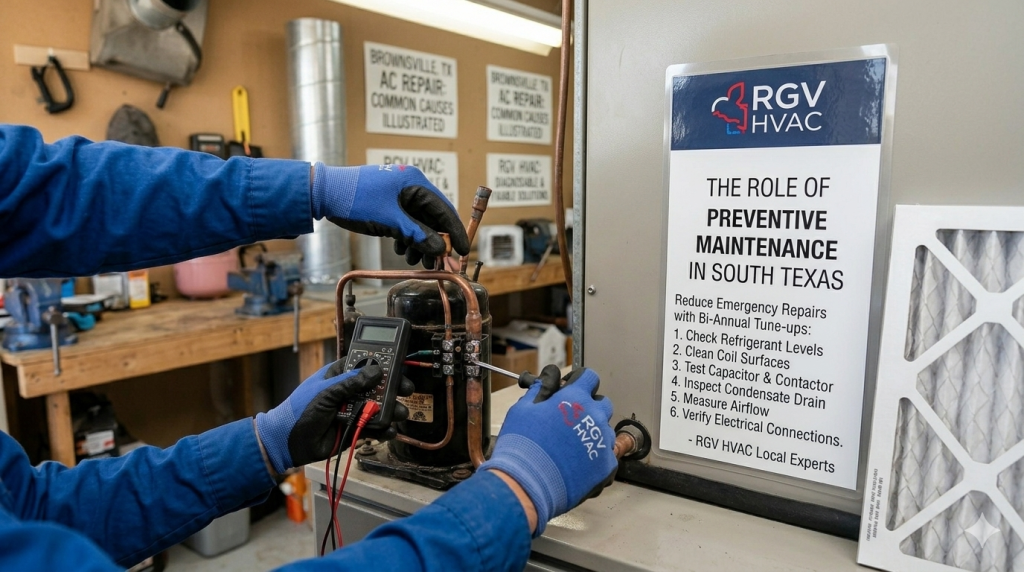
One consistent finding among HVAC professionals in the Rio Grande Valley is that homes with the fewest emergency repairs have the most consistent maintenance histories. Brownsville homeowners can reduce emergency AC failures by scheduling professional tune-ups twice a year, changing filters every 30 to 60 days, and keeping the outdoor condenser unit clear of plants and obstructions.
A professional maintenance visA professional maintenance visit includes checking refrigerant levels, cleaning coil surfaces, testing the capacitor and contactor, inspecting the condensate drain line for blockages, measuring airflow, and verifying all electrical connections are tight and secure. Each task addresses a potential failure before it becomes an emergency on the hottest summer day.
Frequently Asked Questions
Why is my AC running but not cooling my house in Brownsville? The most common causes are a clogged air filter, low refrigerant from a leak, a frozen evaporator coil, a dirty outdoor condenser coil, or a failing compressor. Start by checking your filter and thermostat before calling a technician.
How long should an AC unit last in Brownsville TX? Due to the extreme heat, high humidity, and salt air from the Gulf Coast, most AC units in Brownsville last 8 to 12 years rather than the 15 years that is common in milder climates.
Why does my AC cool in the morning but not in the afternoon? This is a normal response to peak heat load. During the hottest part of the day, your system may only be able to maintain 20 to 25 degrees below the outdoor temperature. Closing west-facing blinds and improving insulation helps significantly.
Can I add refrigerant to my AC myself? No. Refrigerant handling requires an EPA 608 certification. Additionally, adding refrigerant without repairing the underlying leak will not solve the problem and can mask a worsening issue.
How often should I change my AC filter in Brownsville? Every 30 days during summer and every 45 to 60 days during the rest of the year, given the dust, humidity, and nearly year-round operation that South Texas AC systems experience.
What temperature should my AC be set to in Brownsville? Most energy efficiency experts recommend 78°F when you are home and 85°F when the home is unoccupied. A programmable or smart thermostat makes managing this automatically much easier.
Final Thoughts
Living in Brownsville means your air conditioning system is one of the most essential appliances in your home, not a seasonal luxury but a genuine year-round necessity. When it stops cooling properly, the combination of high temperatures and relentless humidity turns an inconvenience into a health concern very quickly.
The causes outlined above cover the vast majority of cooling failures seen in residential properties across Cameron County. Many can be addressed with basic maintenance. Those that require professional attention should not be delayed, because the longer a compromised system runs under stress, the more likely minor problems become major ones.
If you have worked through this list and your home is still not cooling properly, reaching out to a licensed, NATE-certified HVAC technician familiar with South Texas conditions is the right next step. A qualified technician will diagnose the problem accurately, provide transparent pricing, and get your system back to doing what Brownsville homes need most: keeping the heat outside where it belongs.